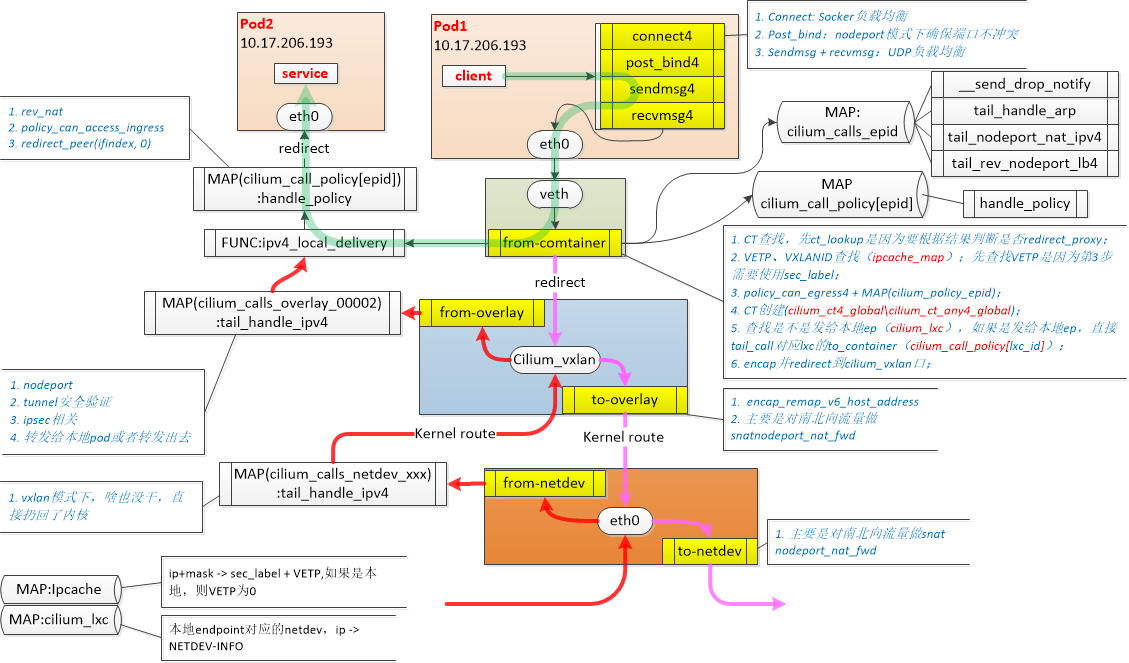
cilium 数据面流程
hook 点 大部分是挂载位置是 tc,tc 是网络协议栈初始处理挂载点
1 2 3 4 5 6 7 __netif_receive_skb_core | list_for_each_entry_rcu(ptype, &ptype_all, list ) {...} | do_xdp_generic | sch_handle_ingress | tcf_classify | __tcf_classify
如果没有下发 policy,xdp 就不会挂载各类 filter 程序
网络设备 cillium 的网络方案不像常规的网桥模式(ovs,linux bridge),datapath 不是一个完整的 run to completion,而是分散在各个虚拟接口上,类似 pipeline 模式
cillium_host: 集群内所有 podCIDR 的网关,地址对容器可见
cilium_net: cilium_host 的 veth 对,ipvlan 模式才会用到?
clilium_vxlan: 用来提供 Pod 跨节点通信 overlay 封装
lxcXXXX: 容器 veth 对在主机侧的接口
同节点 pod2pod cillium_host 是所有 pod 的网关,因此会先 arp request 该地址。arp 相应其实是在 lxc 处被代答了,arp 报文不会走到 cillium_host
1 2 3 4 5 6 7 8 9 10 11 12 13 14 15 16 17 18 19 20 21 22 23 24 25 26 27 28 29 30 31 32 33 34 35 36 37 38 39 __section_entry int cil_from_container (struct __ctx_buff *ctx) { ... case bpf_htons (ETH_P_ARP) : ret = tail_call_internal(ctx, CILIUM_CALL_ARP, &ext_err); break ; ... } __section_tail(CILIUM_MAP_CALLS, CILIUM_CALL_ARP) int tail_handle_arp (struct __ctx_buff *ctx) { union macaddr mac = union macaddr smac ; __be32 sip; __be32 tip; if (!arp_validate(ctx, &mac, &smac, &sip, &tip)) return CTX_ACT_OK; if (tip == LXC_IPV4) return CTX_ACT_OK; return arp_respond(ctx, &mac, tip, &smac, sip, 0 ); }
普通 ipv4 报文,走 handle_ipv4_from_lxc
1 2 3 4 5 6 7 8 9 10 11 12 13 14 15 16 cil_from_container(struct __ctx_buff *ctx) | ep_tail_call(ctx, CILIUM_CALL_IPV4_FROM_LXC) | tail_handle_ipv4(struct __ctx_buff *ctx) | __tail_handle_ipv4(ctx) | tail_handle_ipv4_cont(struct __ctx_buff *ctx) | handle_ipv4_from_lxc(ctx, &dst_id) | __lookup_ip4_endpoint(ip4) | ipv4_local_delivery(...) | ipv4_l3(ctx,...) | tail_call_dynamic(ctx, &POLICY_CALL_MAP, ep->lxc_id) | handle_policy(...) | tail_ipv4_ct_ingress_policy_only(...) | tail_ipv4_policy(...) | ipv4_policy(...) | redirect_ep(...)
相关的 map
CT_MAP_(TCP/ANY)(4/6): conntrack
cilium_lxc:本机 endpoint
cilium_call_policy:pod ep 对应的 policy, BPF_MAP_TYPE_PROG_ARRAY
流程关键点是查cilium_lxc来判断是否 local ep,然后做基本的二层转发
redirect_ep 会根据宏定义判断最后调用 redirect_peer(发往 ifindex 的 peer,也就是容器里的 eth0)还是 redirect(发往 ifindex,也就是 lxc)。
5.10 版本以上的内核建议开启 bpf 的 host_routing 模式。如果 host_routing 模式是 legacy,则不会调用 redirect_ep,而是返回 CTX_ACT_OK。之后通过内核路由表转发到 cillium_host 设备上,走 cil_from_netdev 流程。这样流量会被内核路由表和 iptables 影响,且走了没有用的流程,性能较低。
一般情况下是直接 redirect_peer 发往对端 eth0,因为对端 ep 的 policy 已经在handle_policy中的尾调用执行完毕了。
对端 ep 的 ingress 一般不会加载 bpf 代码,若走 redirect,后续还会执行对端 ep 的 ingress 流程。
1 2 3 4 cil_to_container(struct __ctx_buff *ctx) | tail_ipv4_to_endpoint | ipv4_policy | redirect_ep(ctx, ifindex, from_host)
值得一提的是TAIL_CT_LOOKUP4(ID, NAME, DIR, CONDITION, TARGET_ID, TARGET_NAME)这个宏定义
构造 tuple 查询 ct
将 ct 信息存到 CT_TAIL_CALL_BUFFER4,index 是 0,便于后续处理流程读取
根据宏定义的 CONDITION,决定是否执行下一个尾调用
总共有三处
1
2
3
4
5
6
7
8
9
10
11
12
13
14
TAIL_CT_LOOKUP4(CILIUM_CALL_IPV4_CT_EGRESS, tail_ipv4_ct_egress, CT_EGRESS, is_defined(ENABLE_PER_PACKET_LB), CILIUM_CALL_IPV4_FROM_LXC_CONT, tail_handle_ipv4_cont) TAIL_CT_LOOKUP4(CILIUM_CALL_IPV4_CT_INGRESS_POLICY_ONLY, tail_ipv4_ct_ingress_policy_only, CT_INGRESS, __and(is_defined(ENABLE_IPV4), is_defined(ENABLE_IPV6)), CILIUM_CALL_IPV4_TO_LXC_POLICY_ONLY, tail_ipv4_policy) TAIL_CT_LOOKUP4(CILIUM_CALL_IPV4_CT_INGRESS, tail_ipv4_ct_ingress, CT_INGRESS, 1 , CILIUM_CALL_IPV4_TO_ENDPOINT, tail_ipv4_to_endpoint)
跨节点 pod2pod 在 handle_ipv4_from_lxc 时,__lookup_ip4_endpoint没有查到本地的 ep,走encap_and_redirect_lxc
1 2 3 4 5 6 7 8 9 10 11 12 13 cil_from_container(struct __ctx_buff *ctx) | ep_tail_call(ctx, CILIUM_CALL_IPV4_FROM_LXC) | tail_handle_ipv4(struct __ctx_buff *ctx) | __tail_handle_ipv4(ctx) | tail_handle_ipv4_cont(struct __ctx_buff *ctx) | handle_ipv4_from_lxc(ctx, &dst_id) | encap_and_redirect_lxc(...) | __encap_and_redirect_with_nodeid(...) | __encap_with_nodeid(...) | ctx_set_encap_info(ctx, ...)
encap_and_redirect_with_nodeid还会执行 ipsec 的封装,若不开启则转发到对应的 tunnel device
tunnel_endpoint 是查找 IPCACHE_MAP 得到的,该表类似阿里的 vmnc 表
1
2
3
4
5
6
7
8
$ cilium map get cilium_ipcache Key Value State Error 10.0.2.158/32 identity=13789 encryptkey=0 tunnelendpoint=172.18.0.5 sync 10.0.1.214/32 identity=19140 encryptkey=0 tunnelendpoint=172.18.0.5 sync 10.0.1.213/32 identity=62536 encryptkey=0 tunnelendpoint=0.0.0.0 sync 0.0.0.0/0 identity=2 encryptkey=0 tunnelendpoint=0.0.0.0 sync 172.18.0.4/32 identity=1 encryptkey=0 tunnelendpoint=0.0.0.0 sync 10.0.1.116/32 identity=9049 encryptkey=0 tunnelendpoint=0.0.0.0 sync
ctx_set_encap_info最终会调用 helper skb_set_tunnel_key,再返回CTX_ACT_REDIRECT ,由内核转到对应的 tunnel 设备上
之后执行 tunnel 设备的 tc egress: cil_to_overlay。这边主要是做访问 nodeport 时,重定向发往 remote ep 时的 snat,与 pod2pod 流程无关
之后内核 tunnel 设备会进行 overlay 封装,发往物理网口 netdev
接收端节点,tunnel 设备收到 overlay 报文后,走 tunnel 设备的 ingress tc
此处已经时 tunnel 设备解封装后的报文,最后走 ipv4_local_delivery,和同节点 pod2pod 后面的流程一样
1 2 3 4 5 | cil_from_overlay(struct __ctx_buff *ctx) | handle_ipv4(ctx, &src_identity) | ipcache_lookup4(...) | ipv4_local_delivery(...)
node2pod 在发送端,根据路由表,pod 网段先发送到 cillium_host 设备
1
2
3
4
5
$ ip r 10.0.0.0/24 via 10.0.1.197 dev cilium_host src 10.0.1.197 mtu 1450 10.0.1.0/24 via 10.0.1.197 dev cilium_host src 10.0.1.197 10.0.2.0/24 via 10.0.1.197 dev cilium_host src 10.0.1.197 mtu 1450
tail_handle_ipv4 之后流程类似 pod2pod,本节点就ipv4_local_delivery,跨节点走encap_and_redirect_with_nodeid
1 2 3 4 5 6 7 cil_from_netdev(struct __ctx_buff *ctx) | do_netdev(ctx, proto, from_host) | tail_handle_ipv4_from_host(struct __ctx_buff *ctx) | tail_handle_ipv4(...) | handle_ipv4(...) | encap_and_redirect_with_nodeid(...)
接收端 cilium_vxlan 的 ingress 方向,lookup_ip4_endpoint查询 bpf map cilium_lxc判断是 node 上的cilium_host
1 2 3 4 5 6 7 8 9 | tail_handle_ipv4(struct __ctx_buff *ctx) | handle_ipv4(ctx, &src_identity) | ep = lookup_ip4_endpoint(ip4) | if (ep->flags & ENDPOINT_F_HOST) | goto to_host | to_host: | ipv4_l3(...) | ctx_redirect(ctx, HOST_IFINDEX, 0 )
lb service 替代内核的 NodePort, LoadBalancer services and services with externalIPs 的实现
pod2service 首包流程
1
2
3
4
5
6
7
8
9
10
11
12
13
14
15
16
17
cil_from_container | tail_handle_ipv4 | __per_packet_lb_svc_xlate_4 | lb4_extract_tuple | lb4_lookup_service | lb4_local | ct_lookup4 | lb4_select_backend_id | ct_create4 | lb4_xlate | tail_call_internal(ctx, CILIUM_CALL_IPV4_CT_EGRESS, ext_err) | tail_handle_ipv4_cont | handle_ipv4_from_lxc(ctx, &dst_id) | encap_and_redirect_lxc(...) | __encap_and_redirect_with_nodeid(...) | __encap_with_nodeid(...) | ctx_redirect(ctx, ENCAP_IFINDEX, 0 )
tail_handle_ipv4 过程中查 service 表,若查到走 dnat 流程
dnat 之后的流程和 pod2pod 流程基本一致
reply 流程
主要是做反向 DNAT
1 2 3 4 5 6 7 8 | cil_to_container | tail_ipv4_to_endpoint | ipv4_policy | lb4_rev_nat | map_lookup_elem(&LB4_REVERSE_NAT_MAP, ...) | __lb4_rev_nat | redirect_ep(ctx, ifindex, from_host)
node2service 与 pod2service 的区别是,除了 DNAT 还要做一次 SNAT,源地址统一改成 node 的地址
这是由于访问 service 的流量,可能是节点上来的,也有可能是外部来的。无论如何,都 snat 成 nodeport 地址
相应的,做反向 DNAT 之前要先做反向 SNAT
lb 代码加载位置
默认cil_from_netdev加载在 cillium_host 上
开启 nodeport:cil_from_netdev会加载到物理口的 tc egress 上
开启 LB&NodePort XDP 加速:启动后编译选项 -DENABLE_NODEPORT_ACCELERATION=1
之后 bpf_xdp.c 会编译尾调用CILIUM_CALL_IPV4_FROM_NETDEV
最终cil_xdp_entry流程中会执行 lb 流程
无论是上述哪种加载流程,最终都会执行nodeport_lb4
入向流量
SVC lookup? –> DNAT
endpoint remote?
tunnel or local?
SNAT
fib_lookup
redirect
1
2
3
4
5
6
7
8
9
10
11
12
13
14
15
16
17
18
19
nodeport_lb4 lb4_lookup_servic lb4_local ct_lookup4 lb4_select_backend_id ct_create4 lb4_xlate ct_lookup4 ct_create4 ep_tail_call(ctx, CILIUM_CALL_IPV4_NODEPORT_NAT) tail_nodeport_nat_ipv4 snat_v4_proces snat_v4_handle_mapping snat_v4_lookup snat_v4_new_mapping snat_v4_rewrite_egress fib_lookup eth_store_daddr/eth_store_saddr ctx_redirect
反向流量
rev-SNAT xlation
rev-DNAT xlation
fib_lookup
redierct
1
2
3
4
5
6
7
8
9
10
11
12
13
14
15
16
17
18
nodeport_lb4 lb4_lookup_service ep_tail_call(ctx, CILIUM_CALL_IPV4_NODEPORT_NAT_INGRESS) tail_nodeport_nat_ingress_ipv4 snat_v4_rev_nat snat_v4_rev_nat_handle_mapping __snat_lookup snat_v4_rewrite_headers ep_tail_call(ctx, CILIUM_CALL_IPV4_NODEPORT_REVNAT) nodeport_rev_dnat_ingress_ipv4 ct_lookup4 lb4_rev_nat map_lookup_elem(&LB4_REVERSE_NAT_MAP, &ct_state→rev_nat_index) __lb4_rev_nat ipv4_l3 fib_lookup eth_store_daddr/eth_store_saddr ctx_redirect
ct 表 1 2 3 4 5 6 7 struct { __uint(type, BPF_MAP_TYPE_LRU_HASH); __type(key, struct ipv4_ct_tuple); __type(value, struct ct_entry); __uint(pinning, LIBBPF_PIN_BY_NAME); __uint(max_entries, CT_MAP_SIZE_TCP); } CT_MAP_TCP4 __section_maps_btf;
lb realserver 1 2 3 4 5 6 7 8 9 10 11 12 struct lb4_backend { __be32 address; __be16 port; __u8 proto; __u8 flags; __u16 cluster_id; __u8 zone; __u8 pad; };
通过 cluster_id 解决 ip 重叠问题
snat 表 1 2 3 4 5 6 7 struct { __uint(type, BPF_MAP_TYPE_LRU_HASH); __type(key, struct ipv4_ct_tuple); __type(value, struct ipv4_nat_entry); __uint(pinning, LIBBPF_PIN_BY_NAME); __uint(max_entries, SNAT_MAPPING_IPV4_SIZE); } SNAT_MAPPING_IPV4 __section_maps_btf;
pod2external 1 2 3 4 5 6 7 8 9 10 11 cil_from_container(struct __ctx_buff *ctx) | ep_tail_call(ctx, CILIUM_CALL_IPV4_FROM_LXC) | tail_handle_ipv4(struct __ctx_buff *ctx) | __tail_handle_ipv4(ctx) | tail_handle_ipv4_cont(struct __ctx_buff *ctx) | handle_ipv4_from_lxc(ctx, &dst_id) | ret = encap_and_redirect_lxc(...) | if (ret == DROP_NO_TUNNEL_ENDPOINT) goto pass_to_stack | pass_to_stack: ipv4_l3(...) | return to stack
remote endpoint 未查到,返回 DROP_NO_TUNNEL_ENDPOINT
之后发往内核协议栈,内核可能有 iptables 规则 nat 成 nodeport
接收回包时,内核根据出方向 Masquerade 的情况做反向 nat,之后查内核路由表发给cilium_host。最后走 cil_from_netdev,转给对应的 pod
参考资料 Life of a Packet in Cilium: Discovering the Pod-to-Service Traffic Path and BPF Processing Logics
cilium LB 源码分析 - 知乎
Cilium 数据平面深度解析 1 - 基础连通性
Cilium datapath 梳理 | REXROCK